

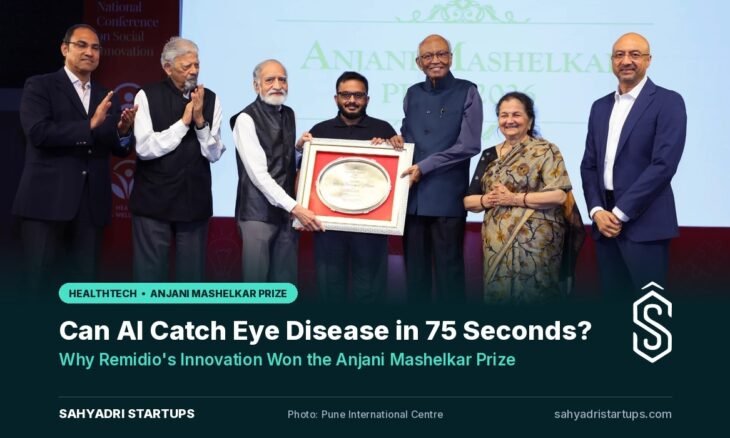
Bengaluru-based Remidio Innovative Solutions has won the 2026 Anjani Mashelkar Prize for developing portable retinal imaging and offline artificial intelligence (AI) technology that enables diabetic-retinopathy screening outside conventional eye-care facilities.
Its approach allows trained health workers to capture retinal images and obtain AI-assisted screening results directly on a smartphone, without relying on internet connectivity or sending patient images to external servers for processing.
The 2026 Anjani Mashelkar Prize was presented at the 14th National Conference on Social Innovation, hosted by Pune International Centre (PIC) on November 17.
The award was presented by Kiran Karnik, Chairperson of HelpAge India and former NASSCOM President; Dr. R. A. Mashelkar, Chairman of the Anjani Mashelkar Foundation and President of PIC; and Dr. Vijay Kelkar, Vice President of PIC. Remidio Founder Dr. Anand Sivaraman received the award on behalf of the company.
The recognition highlights Remidio’s work in addressing a critical healthcare access challenge: making specialised eye screening available in communities where ophthalmologists and advanced diagnostic infrastructure may not be readily accessible.
Unlike conventional screening models that depend on specialist-led examinations, Remidio’s approach combines a portable retinal camera with AI software to decentralise the initial screening process.
This allows frontline healthcare workers to capture images and identify patients who may require further examination by an eye specialist.
The technology’s relevance lies not just in automating image analysis but in making the screening process deployable at the point of care, including resource-constrained settings.
Why Remidio’s Offline AI Approach Matters
Diabetic retinopathy, a complication of diabetes that can lead to vision loss, requires timely detection. However, access to retinal screening remains a challenge in areas with limited eye-care infrastructure.
Remidio’s Fundus on Phone camera and Medios AI software are designed to address this gap. The system enables retinal imaging and AI-assisted analysis without requiring images to be uploaded to a cloud server.
The model was evaluated in a 2019 study published in JAMA Ophthalmology at municipal dispensaries in Mumbai. A health worker who had received less than two weeks of training captured retinal images, which were subsequently assessed by ophthalmologists.
Of the 213 patients included in the final analysis, the AI system identified all 15 patients with referable diabetic retinopathy according to the ophthalmologists’ assessments. The study reported 100% sensitivity and 88.4% specificity.
However, the findings came with limitations. Eighteen of the original 231 participants were excluded because their images were considered ungradable.
The small number of positive cases also meant that the sensitivity estimate had a wide 95% confidence interval of 78.2-100%. The researchers called for larger studies before extending the findings to general-population screening.
A more extensive evaluation published in The Lancet Digital Health in 2025 examined eight automated retinal-image analysis systems using 201,438 screening encounters involving 126,365 people with diabetes.
Identified as System G, Remidio’s platform recorded sensitivity of 80.3% for referable diabetic retinopathy when encounters with ungradable human assessments were included. The figure increased to 87.0% when those encounters were excluded.
The study also reported detection rates of 98.9% for moderate-to-severe non-proliferative diabetic retinopathy and 97.1% for proliferative diabetic retinopathy.
Together, the studies demonstrate the potential of Remidio’s technology for decentralised diabetic-retinopathy screening, while also highlighting the importance of image quality and appropriate clinical follow-up.
Anjani Mashelkar Prize Focuses on Affordable Healthcare Innovation
The Anjani Mashelkar Prize, instituted by the Anjani Mashelkar Foundation, recognises innovations that combine technological excellence with affordability and accessibility for underserved communities.
Its 2026 criteria specifically include digital-first, point-of-care healthcare and medical technology solutions with the potential to scale across India.
This makes Remidio’s approach particularly relevant to the award’s objectives. By combining portable imaging hardware with offline AI, the company is attempting to reduce the dependence of retinal screening on specialist facilities and make the technology usable by trained frontline workers.
Beyond the customary ₹1 lakh prize, the award offers access to investment of up to ₹2 crore, subject to due diligence, along with market access and expert support.
“Remidio’s game-changing portable, non-invasive platform reveals the eye’s power to detect life-threatening conditions, opening up possibilities to make healthcare a basic human right for excluded communities in India and across the world,” said Dr. R. A. Mashelkar, Founder Chairman, Anjani Mashelkar Foundation.
Remidio’s Global Deployment and Expansion into Maternal Healthcare
Remidio says its devices have screened more than 16 million people across 55 countries. Bill Gates also referred to the company’s reach of more than 15 million patients across 40 countries in an April 2026 essay.
The company has also secured US FDA 510(k) clearance for its Fundus on Phone NM-10 ophthalmic camera in December 2025.
The clearance covers the device’s imaging function, including capturing images of the fundus and the surface and surrounding areas of the eye. It does not establish FDA approval of all the AI software’s disease-screening claims.
Remidio is also exploring retinal imaging applications beyond eye diseases. The Gates Foundation has recorded funding commitments of $1.27 million in March 2026 and $2.20 million over 35 months from November 2026 for research into using retinal imaging and AI to assess pregnancy-related health risks, including pre-eclampsia and gestational diabetes.
“We are truly honoured to receive the prestigious Anjani Mashelkar Prize. Dr. Mashelkar’s ‘more from less for more’ has been our compass. Next, we turn the eye into a window to a person’s overall health, for everyone. India’s moment as a product nation is here,” said Dr. Anand Sivaraman, Founder of Remidio.